


SEO, AEO and GEO: What You Should Know Before Your Next Website Redesign
Ask a question online today and you may never see a list of websites at all. You get a written answer, and somewhere inside it one or two businesses get named. If yours is not one of them, you are not on page two. You are not in the conversation.
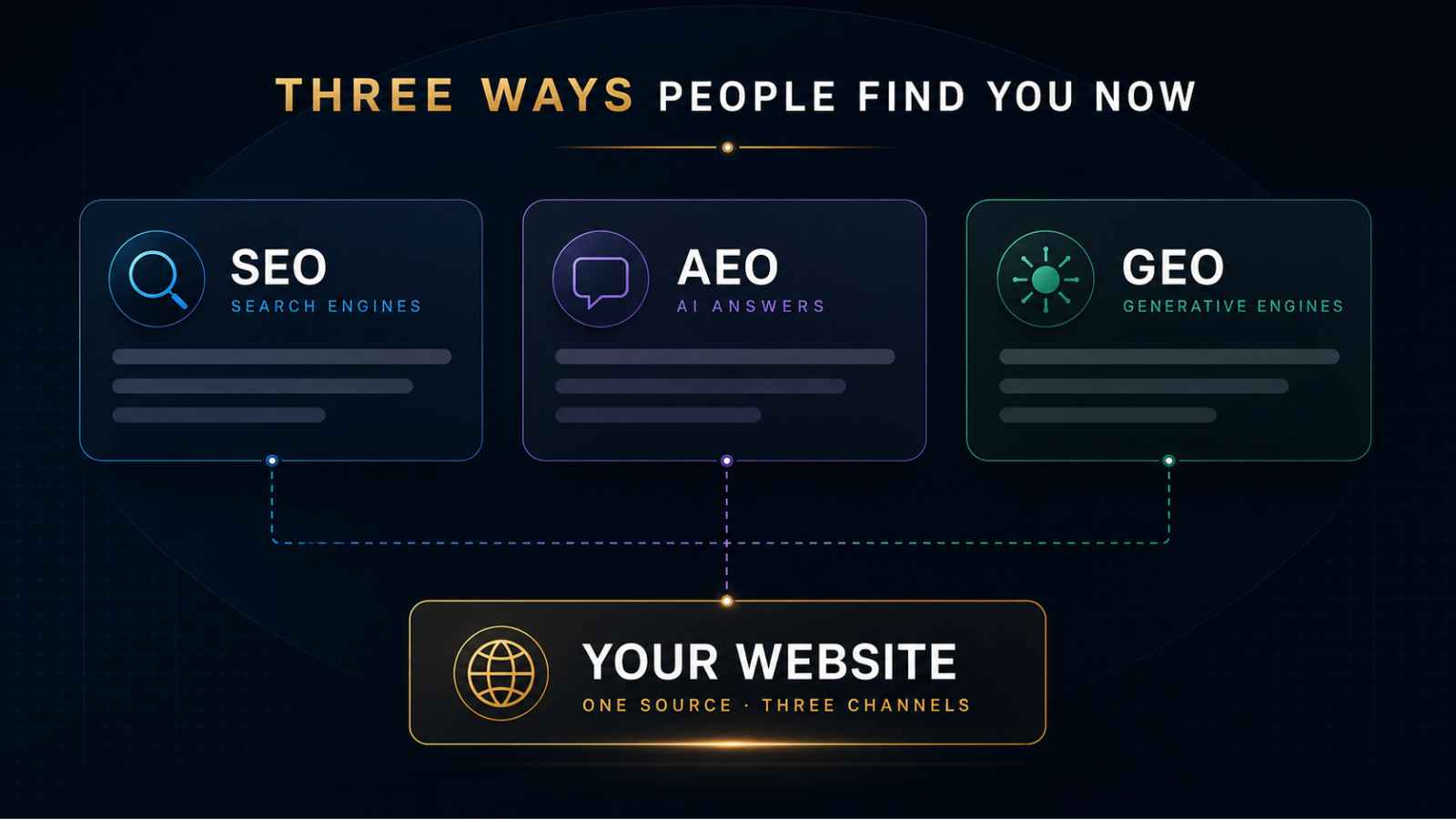
That is the shift behind three letters you will keep hearing this year: SEO, AEO and GEO. They are not competing fashions or agency jargon invented to sell a package. They are three different doors into the same building — and most business websites in Cambodia were built when only one of those doors existed.
The three, in plain language
SEO — Search Engine Optimisation. The one you already know. It decides whether your page appears when someone types a query into Google, and how high. Keywords, links, speed, mobile, titles and descriptions. Twenty years old and still the foundation.
AEO — Answer Engine Optimisation. Being the source that *answers* the question rather than one of ten links offered. This is the featured snippet at the top of Google, the voice assistant reading a sentence aloud, the box that says "according to…". The question is no longer "do we rank?" but "are we the answer?"
GEO — Generative Engine Optimisation. Being represented correctly inside what an AI writes. When someone asks ChatGPT, Gemini or Claude to recommend a web design company in Siem Reap, something has to be in the model's reach for your name to appear. GEO is the work of making sure your business is legible to those systems.
A note of honesty here, because plenty of articles gloss over it: AEO and GEO overlap heavily, and many practitioners use the terms interchangeably. The distinction that matters is not the acronym. It is that answering and being quoted are now separate outcomes from ranking, and a website built only for ranking will quietly lose both.
Why this changed so fast
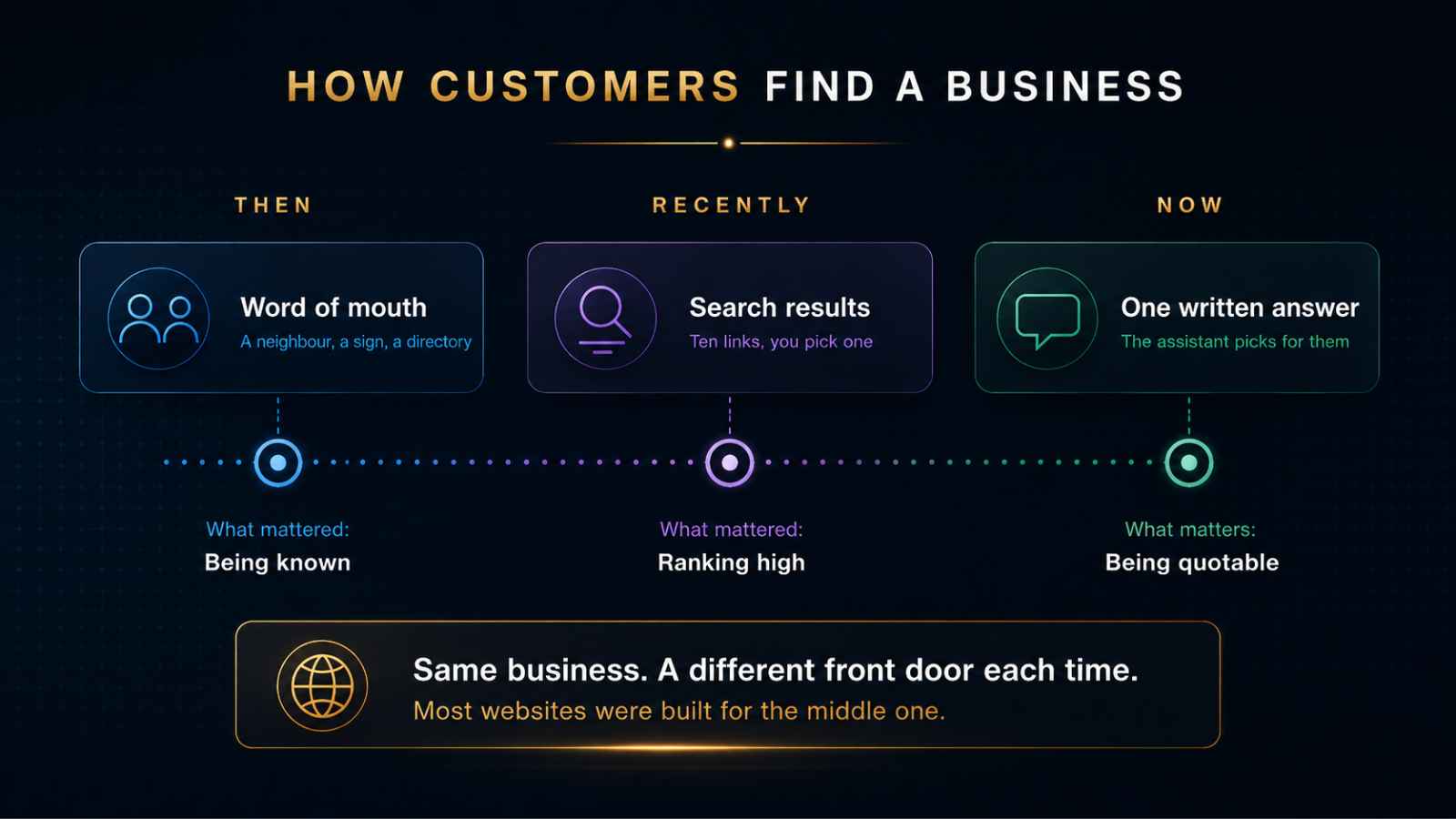
For twenty years the deal was simple. A search engine found your page, showed a link, and the visitor clicked. You got the traffic, and traffic was the product.
Generative search broke that deal. The assistant reads the pages, writes one answer, and names its sources. The visitor may never see a list. What you are competing for is no longer a position — it is a citation.
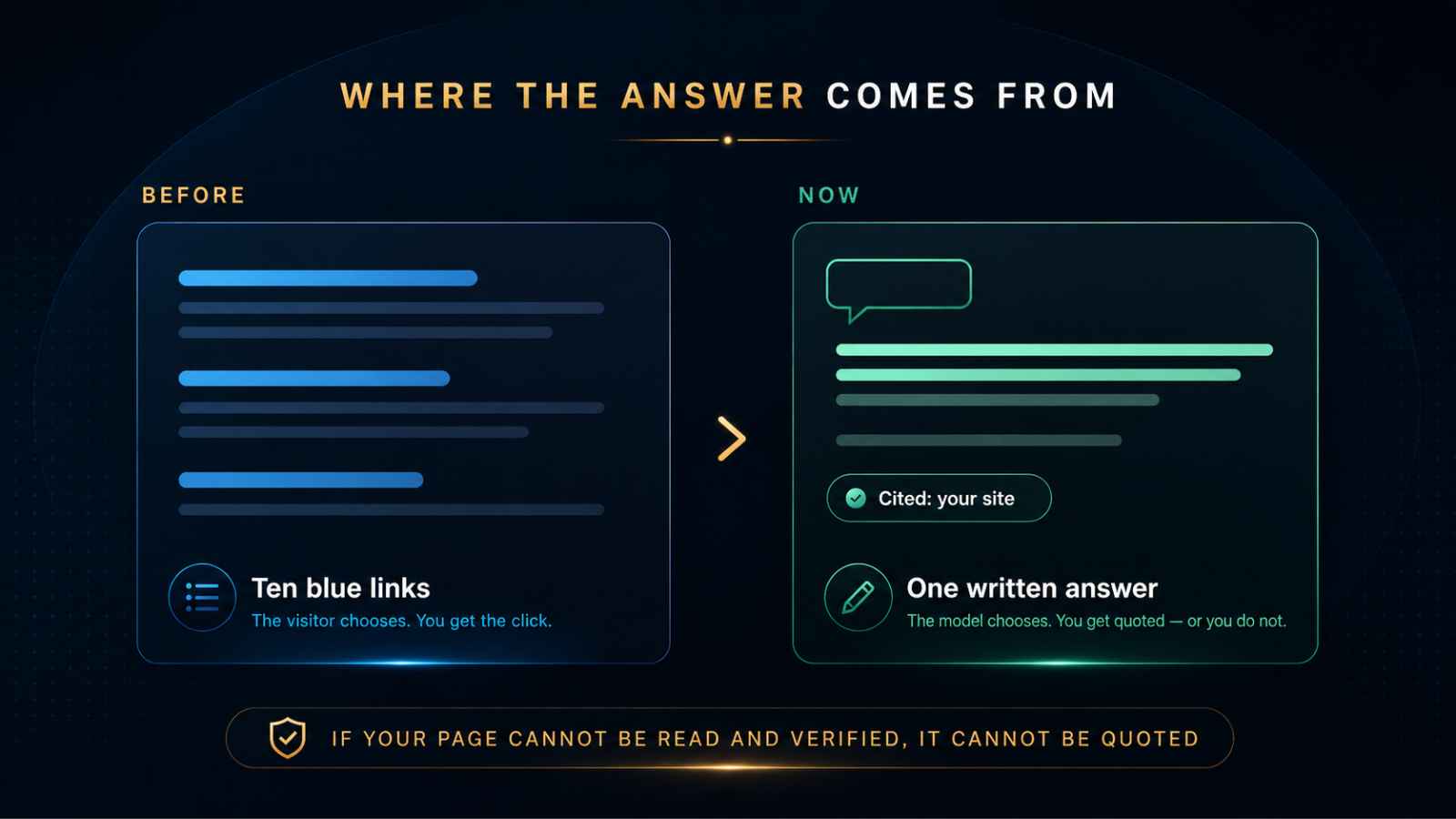
This is not a prediction. AI crawlers already visit websites daily under their own names — GPTBot, ClaudeBot, PerplexityBot and others — reading pages exactly as they are published. They arrive whether or not you have prepared for them. The only question is what they find.
What an assistant needs before it will quote you
Language models are cautious about naming a business. They tend to reach for sources they can parse cleanly and corroborate. In practice that means a handful of unglamorous things:
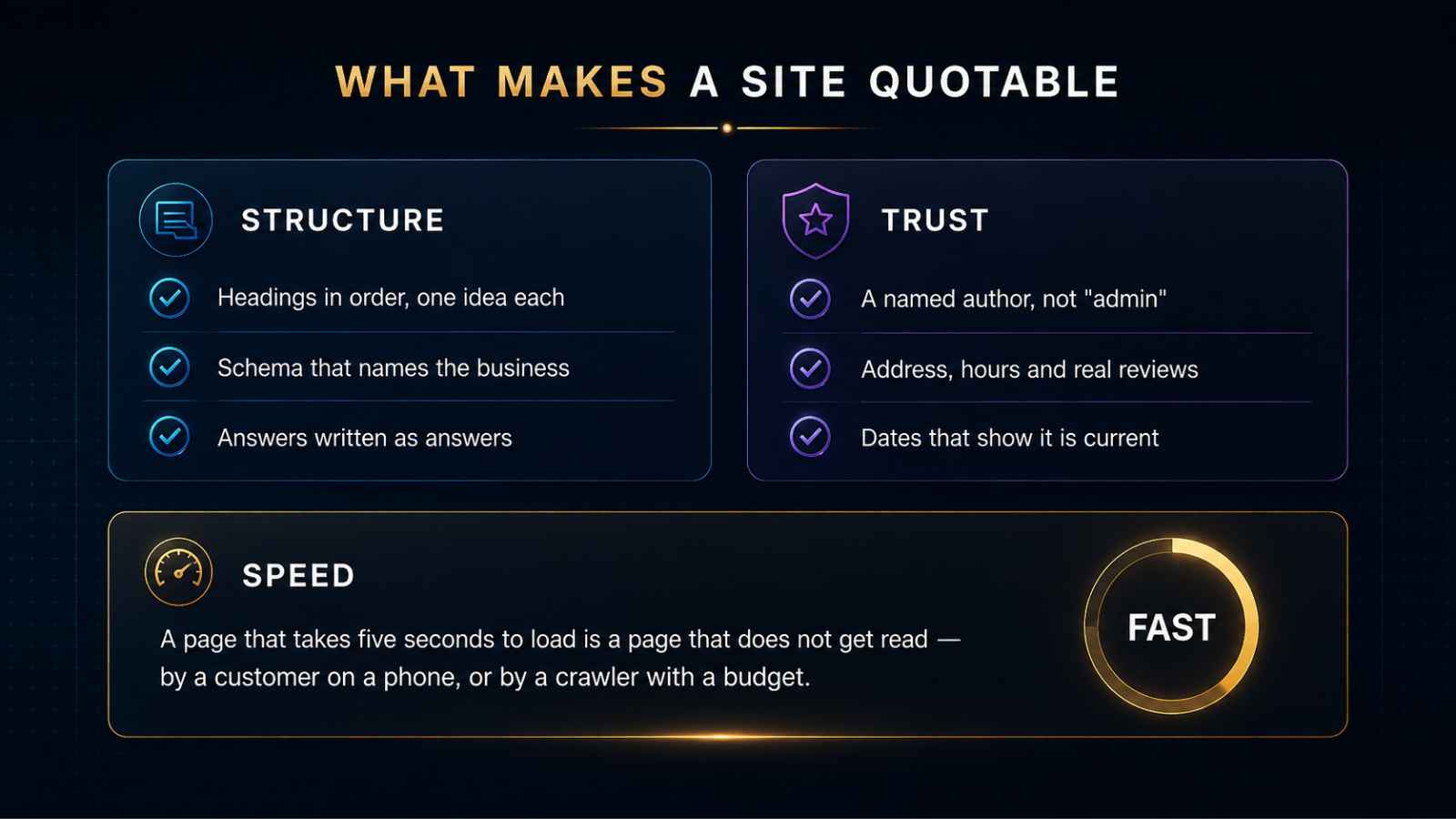
- Structure it can follow. Headings in order, one idea under each, and answers written as answers. A model extracting a fact from a page needs to find where the fact ends.
- Facts stated in machine-readable form. Structured data — schema — that says in so many words: this is the business, this is the address, these are the services, this is who wrote the article. Prose alone leaves it guessing.
- A named human behind the advice. Content attributed to a real person with a verifiable background is treated very differently from content signed "admin".
- Corroboration. The same business name, address and phone number, stated the same way, in more than one place.
- Speed. A page that takes five seconds to load is a page that does not get read — not by a customer on a phone, and not by a crawler working to a budget.
Notice what is *not* on that list: keyword density, more pages, a bigger blog. The work has moved from persuading a ranking algorithm to making a site genuinely easy to read and hard to doubt.
Why an old website struggles with all three
Most websites we are asked to look at were built between 2015 and 2021. They are not broken. They load, they look reasonable, the contact form works. But they were built for one door, and it shows:
- The page is one long block of text with headings chosen for looks rather than order, so nothing can be extracted cleanly.
- There is no structured data at all, so the business exists on the page as pixels and nowhere as facts.
- Articles are signed by the company, or by nobody.
- The theme carries a decade of plugins, and the site takes four or five seconds on a phone.
- Opening hours live in an image. The address is in the footer graphic. The phone number is written three different ways on three different pages.
None of that was a mistake when the site was built. It is simply a house with one door, in a year when customers started arriving at three.
What we changed on our own site — and what it cost
We would rather show than claim. Over the past month we rebuilt angkordesign.com on the same principles we are describing:
- Every page now carries structured data that names the business, its address and its services, all pointing at one identity rather than repeating themselves.
- Every article names its author, a real person with a profile page, and states when it was published and when it was last touched.
- The 232-term glossary and the FAQ pages are marked up as definitions and questions, so an assistant can lift a single answer without swallowing the whole page.
- We publish an
llms.txtfile — an emerging convention that gives AI systems a clean map of the site — and a long-form version alongside it. - Our analytics now separates AI crawlers from human readers, so we can see which assistants are reading what. You cannot improve a number you are not measuring.
None of this required more content. It required the content we already had to be structured, attributed and fast.
Is it time to redesign, or just to repair?
An honest answer: not every site needs rebuilding. Ask these five questions about yours.
- Does your business appear when you ask an AI assistant to recommend a company like yours in your city? Try it. The answer takes thirty seconds and it is usually clarifying.
- Does the site state your address, hours and services as data, not only as text a person can read?
- Do your articles carry a named author and a visible date?
- Does the site load in under two seconds on a phone, on mobile data, not office wifi?
- Can you edit it yourself without calling a developer?
Two or three "no" answers usually mean targeted work — schema, speed, structure — on the site you have. Four or five, and you are paying to maintain a house you cannot add doors to. That is when a redesign is cheaper than the repairs.
Where to start
Start with the audit, not the design. Before anyone discusses colours, you should know how your current site performs against all three doors, and which of your pages are already close enough to be worth fixing rather than replacing.
We have been building websites, online stores and mobile apps for businesses since 2005, from Siem Reap and Phnom Penh, for more than a thousand businesses. Domain, hosting, design, development and support come from one team, which matters here more than it used to: SEO, AEO and GEO are not three separate jobs you can hand to three separate suppliers. They are the same job, done properly, once.
If you would like to know where your website stands, tell us about your project and we will look at it and tell you honestly whether it needs a redesign or a repair. The consultation is free, and if the answer is "repair", we will say so.